
Color psychology looks at how color affects people in general. This post is about how it speaks to you.
I think of color as a somatic language: a way your body communicates what it needs, what it is processing and what it is becoming. The shade you reach for in the morning, the one you avoid, the one you can’t stop thinking about: none of it is random. “Somatic” simply means “of the body,” and color is one of the fastest things your body takes in. It skips logic and lands in sensation.
What your color cravings are telling you
Have you ever noticed that you:
- reach for blue when you’re overwhelmed?
- crave red or orange when you need energy?
- soften into green when you’re healing?
- suddenly want pink or violet when something in you is opening?
That isn’t only taste. Very often it’s your nervous system asking for support. A craving is your body voting for the state it wants to be in.
What your color avoidances are telling you
The colors you avoid are information too. Sometimes a color simply doesn’t flatter you. But sometimes it carries a memory, or asks for a kind of visibility you aren’t ready for yet.
You don’t have to wear it. Just get curious. “Why not this one?” is often where the most interesting work begins.
Your colors change as you do
Your patterns tell a story over time. Are you shifting from dark colors into brighter ones? Craving softness after a season of intensity? Pulling toward boldness after a long time of playing small? Follow those shifts on purpose, and you stop guessing who you are and start experiencing it.
Color therapy: an ancient practice
Long before anyone measured a wavelength, people were using color to change how they felt. Chromotherapy, or color therapy, is the name we give that practice today.
Where color therapy comes from
- Ancient Egypt built sunlit healing spaces and gave colors spiritual meanings tied to their gods and minerals.
- India’s Ayurvedic tradition linked color, light and the body’s energy.
- Ancient Greece associated colors with the body’s balance, and color appeared in early medical writing.
- The rainbow chakra chart many people know today is a more modern blend of older Indian ideas with twentieth-century Western color theory.
- In the 1800s and early 1900s, Western practitioners experimented with colored glass and light boxes, sometimes with big promises the science never backed up.
What science supports, and what it doesn’t
It’s important to be honest here. Color therapy is a complementary practice, not a medical treatment.
Some uses of light are well studied. Bright light therapy is an established treatment for seasonal depression, and the color of light affects our sleep: blue-rich light keeps us alert, and warm, dim light helps us wind down. But claims that specific colors cure specific illnesses aren’t supported by research.
What research and everyday experience do support is that color affects mood, attention and how safe or energized we feel in a space. That’s the ground I stand on. I use color as a gentle input you can choose and notice, alongside, never instead of, rest, relationships and professional care.
Color and the sensitive nervous system
For many people, and especially for autistic, ADHD and other neurodivergent people, sensory experience is heightened and specific. We often know exactly what feels wrong: the fabric that itches all day, the room that’s too bright, the noise that won’t stop. We’re less practiced at naming what feels right.
When bright colors feel like too much
If you’re sensitive to light, highly saturated colors can feel like a fluorescent bulb: buzzy, loud and hard to be around for long. That isn’t a flaw. It’s precise information. Many light-sensitive people feel calmer in:
- Pastels and tints, like Powder Pink, Ice Blue and Wisteria, which ask less of the eye.
- Muted tones, like Sage Green, Mist Gray and Olive Drab, which feel lived-in and steady.
- Fewer colors at once. A one- or two-color outfit often feels better than a busy print.
If you want a bright color in your life, try it somewhere you can see it but not wear it at your face, like a bag or a bracelet.
Texture matters as much as color
For a sensitive body, fabric can make or break a day. Scratchy seams, stiff synthetics and fabrics that trap heat keep the body on alert for hours. That’s a big reason I work in rayon. It drapes like water, breathes and moves with you. When the fabric stops demanding attention, there’s room to actually feel the color. More in Choosing Fabrics to Dash Dye.
Sessions built for sensitive bodies
My sessions are quiet and unhurried, one-on-one in my Grand Rapids studio, at your pace. Tell me what you need ahead of time: lower lights, no music, breaks, fewer colors at once or a support person. There’s no performance and no small talk required. You hold colors until one holds you back. I share why this matters so much to me in Embracing Neurodiversity.
Build a daily color toolkit
You don’t need a whole new wardrobe to work with color this way. Start with three pieces:
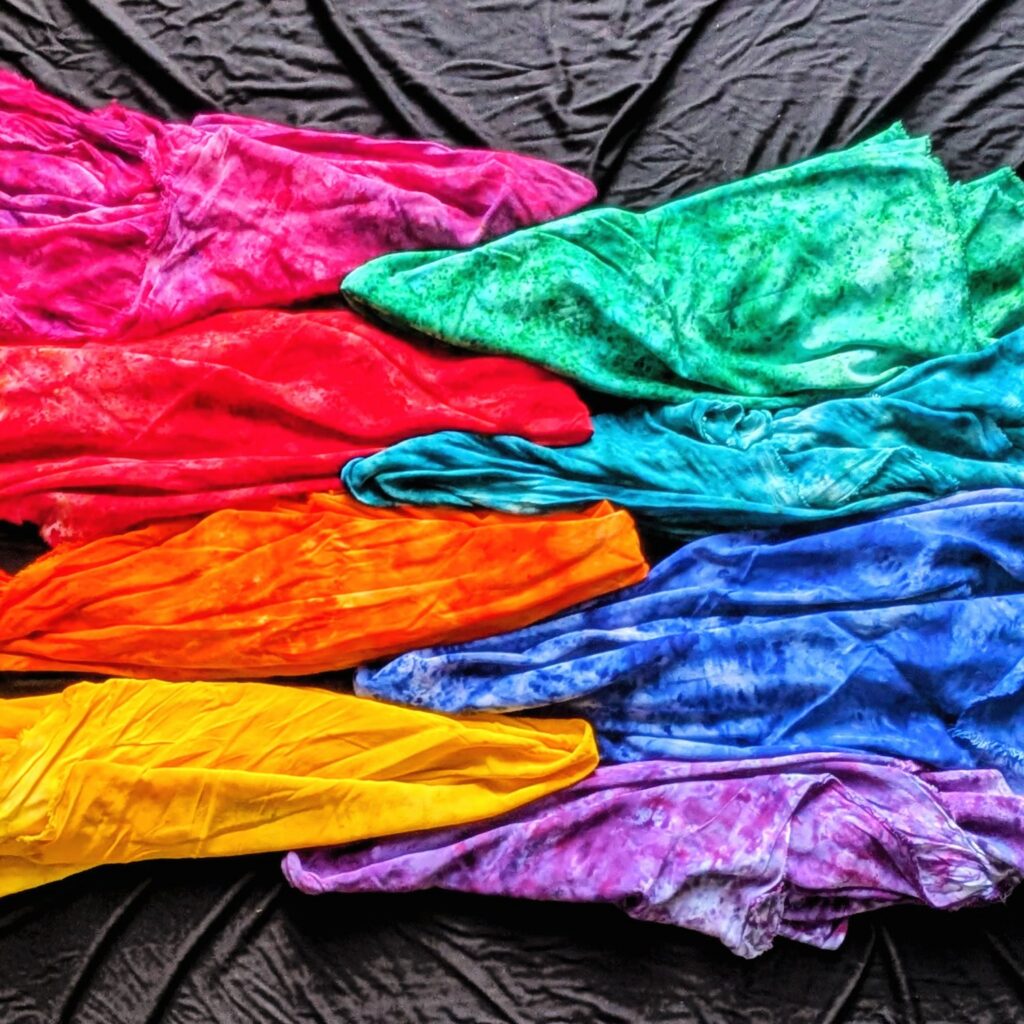
- A calming piece, like a blue or soft green scarf, for days you feel overwhelmed.
- A bright piece, like a coral, marigold or clear teal layer, for days you feel low.
- A grounding piece, like a brown or deep neutral wrap, for evenings and hard conversations.
Calming
Bright
Grounding
Keep them where you can grab them, and notice what happens when you do. You don’t need to take any of this on faith. Try it, notice what happens and let your own body correct the list.
A four-step practice for listening to color
- Notice your current color. What have you worn most this week? Look back at your last seven outfits.
- Name the pull. What color are you craving but not wearing?
- Introduce it gently. Start small: a scarf, a wrap or a layer you can take off.
- Observe your body. Do you feel more open? More grounded? More expressive? Less? That response is your feedback.
What color is anxiety for you? What color is hope? Add yours in What Color Is a Feeling?
Why wearing color works
Light changes when you turn it off. A piece of clothing stays. When you choose a color and dash it onto fabric yourself, you make a decision your body recognizes, and every time you put the piece on, you’re reminded of that choice.
That’s where color therapy meets the oldest human habit of all: changing our clothes to change how we feel.
Begin here
Begin with one color
You don’t need a plan or a diagnosis to start. You need a few swatches and a body that’s willing to listen. Come find out what your hand reaches for, in a quiet one-on-one session or with activated dyes at home.
More joy is possible.
Your next step
Book A Color Revival
Three hours to revive your whole closet in the colors that are truly yours: an in-depth color analysis, a closet edit, six pieces dash-dyed as a capsule that mixes and matches, and ten styled photos of you in it.
More joy is possible.