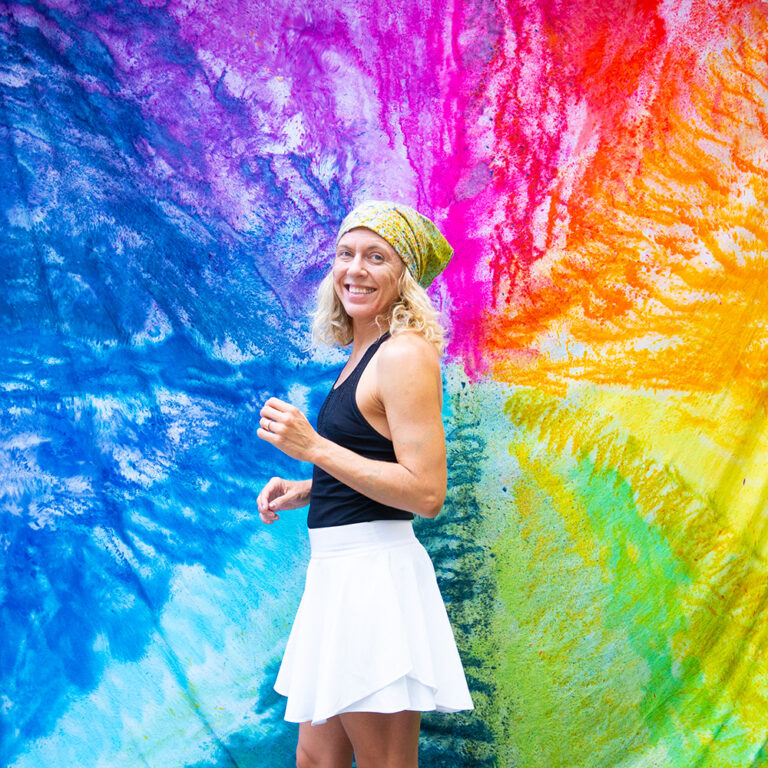
Every brain is a brushstroke in the masterpiece of humanity, each one adding its own shape, rhythm and color. At More Joy Studio, I have watched something magical happen again and again when people are given the freedom to create, feel and exist without interruption.
I honor the full spectrum of neurodiversity, and I want to invite you into a more colorful, inclusive and joyfully alive way of being. This is personal for me. I’m autistic, and color is how I make sense of the world. It’s also why there’s a rainbow infinity sign in my logo: a symbol many autistic people use for neurodiversity, tucked in so you’ll know you belong here.


My turning point
I was diagnosed as autistic shortly after I got sober. It was one of the most clarifying moments of my life.
So much of my story suddenly had a new frame. Being homeschooled. Starting college full time at 14. Pouring myself into building a web design business. Drinking to quiet a world that always felt too loud. I hadn’t been too much, or not enough. I had a nervous system no one had named yet, and I had spent years masking it.
The diagnosis didn’t change who I was. It gave me permission to stop apologizing for it. And it pointed me straight toward the work I do now. (I share the recovery side of this story in Recovery Through Practice.)
Color as sensation, not decoration
My brain takes in color the way it takes in music or texture: as sensation. A particular blue can settle my body the way a weighted blanket does. A buzzy yellow on the wrong day can feel like a fluorescent light.
That sensitivity isn’t a flaw to manage. It’s precise information. Many people I work with have never been offered color in a way their nervous system could receive: too many choices, too much pressure, too much noise around the process. When the noise drops away, people can finally feel what they’re drawn to.
When a fixation becomes expertise
Autistic deep focus gets a bad reputation. Given the right subject and enough room, it becomes mastery.
Years of sustained attention mean I know all 150 of my colors by name, by feel and by the response they tend to create. I can usually match someone to their dyes within three or four swatches. That isn’t a party trick. It’s what happens when a brain is allowed to go all the way into the thing that lights it up.
Space to hyperfixate is space to invent
So many of the world’s great inventions, breakthroughs and artworks came from people who were allowed to hyperfixate: to tune out the world and go all in on the spark that lit them up.
But in a noisy, fast, productivity-obsessed culture, we often interrupt the very people whose focus could guide us.
I want to flip that script. In my studio, you can create without being interrupted. You don’t need to mask, translate or apologize for how your mind works. Sensory needs aren’t merely accommodated. They’re respected. And joy isn’t reserved for neurotypical people. It’s something all of us get to feel, especially when we create from an authentic place.


We don’t need you to produce. We need you to be.
Some people tie a person’s value to their productivity. It’s a narrow and soulless version of humanity.
So let me be clear. If you never contribute in the ways society recognizes, if you never achieve or accomplish or earn, you are still worthy. You are still valuable. You are still a blessing. Not because of what you do, but because of who you are.
My work isn’t about extracting value from people. It’s about reflecting it back to them: in color, in fabric, in movement, in laughter and in softness.
Clothing that feels right on the body
For many neurodivergent people, getting dressed is a sensory negotiation. I teach people, especially people who have never felt seen, how to feel good in what they wear, how to reclaim clothes that used to feel like costumes and how to shine in their own spectrum.
- Soft, breathable fabric like rayon, so the clothes stop demanding attention.
- No scratchy tags or stiff seams.
- Colors that calm rather than overwhelm, which for many sensitive people means softer tints and muted tones.
- Fewer colors at once, so the eye has somewhere to rest.
I explain the science of color and the sensitive nervous system in Color as Somatic Language.
Those choices are why I design the way I do. The pieces I sew have no sewn-in tags, as few seams as I can manage and soft, flowing rayon, and many are one generous piece of fabric you wrap, drape and tie however feels right. See every detail, and why, on The Look.
What the research says about clothing and comfort
I’m not a researcher, and I don’t make health claims. But these studies put words to things I’d felt my whole life, and they might for you too.
- Fabric matters. In Clothes, Sensory Experiences and Autism: Is Wearing the Right Fabric Important? (Kyriacou, Forrester-Jones and Triantafyllopoulou, Journal of Autism and Developmental Disorders, 2021), ten autistic adults handled fabric samples and brought their own favorite fabrics to talk about. The researchers found that some fabrics affected participants’ reported well-being, and that familiar textures helped some of them cope.
- Comfort can limit self-expression. In “I feel trapped in my safe clothes” (Knight and Birtles, Autism, 2025), 86 autistic adults described their clothing experiences. Labels, seams, scratchy fabrics and tight clothes were the most disliked, and sensitivity limited people’s ability to express their identity through what they wore. Many felt they had to choose between comfort and the style they wanted, and the authors called for more sensory-friendly clothing.
- Sensitive doesn’t mean “less.” In In Our Own Words: The Complex Sensory Experiences of Autistic Adults (MacLennan, O’Brien and Tavassoli, Journal of Autism and Developmental Disorders, 2022), autistic adults described seeking out some textures, patterns and bright colors while finding others overwhelming. Being sensitive doesn’t mean disliking all sensation.
That last one is my whole wardrobe. I can’t stand a scratchy tag, and I want to be wrapped in the brightest color in the room. So the question at the center of More Joy is simple: why should anyone have to choose between looking expressive and feeling comfortable?
I don’t expect every autistic person to experience my clothing the way I do. Comfort is personal. That’s why I’d love to know what you love to touch, for the Touch Me Line I’m developing.
Sessions designed with neurodiversity in mind
I’m not only talking about inclusion. I try to practice it. Every private session and group gathering is designed with neurodiversity in mind, because I believe:
- No one should be excluded because they stim, mask or need a break.
- Artistic expression belongs to everyone, especially people who have never been invited to the table.
- Your joy matters, just as you are.
If you have sensory needs, tell me before your session. We can lower the lights, turn off the music, slow down, take breaks, bring a support person or narrow the choices so the colors don’t overwhelm. Whatever helps you feel safe enough to play.
You can always change your mind
As an autistic practitioner, I live alongside my own anxiety, so I build sessions the way I’d want them built for me. Tucked into every session are moments where you can pause and change your mind: about a color, about a piece, about whether you want to keep going.
Dash-dyeing makes that possible in a way most tie-dye doesn’t. With traditional tie-dye, you fold, bind and walk away for hours, and gravity decides the pattern. With dash-dyeing, you’re watching the color land in real time. If a section needs more red, add red. If it’s starting to feel like too much, stop. Nothing is locked in until you say so.


What you can do
- Create space, not noise. Let someone hyperfixate, feel deeply and take their time.
- Choose delight over judgment. Look for the humanity in someone’s difference.
- Support people and organizations working to dismantle ableist ideas.
- If you’re neurodivergent, create with me. You are not a problem to solve. You are a color we haven’t seen yet.
Try this
Think of a time you were deep in a hyperfocus or a favorite activity and someone interrupted you. Notice how your body remembers it. Now picture the same moment with no interruption at all. What would you have made? Give yourself one uninterrupted hour this week to find out.
The world gets more joyful when we stop trying to fix people and start learning from them instead.
Begin here
Begin with one color
You don’t need a plan or a diagnosis to start. You need a few swatches and a body that’s willing to listen. Come find out what your hand reaches for, in a quiet one-on-one session or with activated dyes at home.
More joy is possible.