
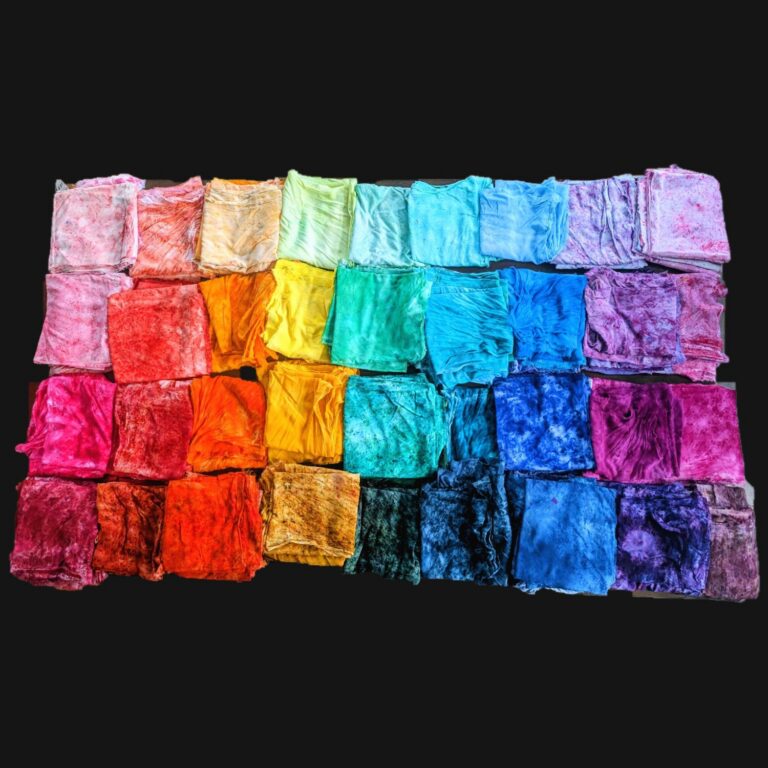
What does red mean? Why does blue calm so many people? Why is purple tied to royalty? Every color family carries thousands of years of human history, a little physics and a feeling that lands in the body before we can name it.
I organize all 150 of my activated dyes into ten color families. I call them Color Genres. This guide walks through the meaning of each one: where it comes from, why it looks the way it does and how it tends to feel to wear.
A few things to know before you start:
- Color meanings aren’t universal. Culture, memory and context change them. White means purity in some places and mourning in others. Treat these as starting points, not rules. (More in Color Psychology.)
- Every family has warm and cool versions. If you think you “can’t wear” a color, you may just need a different temperature of it. (More in Color Temperature.)
- The feeling matters most. If a color makes your shoulders drop or your chest open, that is information worth more than any chart.
Tap a family to jump to it.
Red


What red means
Energy, courage, visibility. Red reaches you before you decide to look. It may be the oldest color humans used on purpose: people were grinding red ochre for pigment more than 100,000 years ago. Later, reds made from tiny insects (kermes, then cochineal) were traded like precious metals, and in China red has long meant luck and protection.
The science of red
Red has the longest wavelength we can see, and red objects can seem to sit a little closer than they are. It is also the first color to fade at dusk.
In my collection: soft pinks like Baby Pink and Powder Pink, clear reds like Chinese Red and Fire Red, and deep reds like Oxblood Red and Red Wine.
Go deeper: The full guide to red → · The full guide to pink →
Orange


What orange means
Play, warmth, connection. Orange keeps red’s energy but softens it, so it says “come closer” instead of “look at me.” English had no word for it until the fruit arrived; the color was once called “yellow-red.” Buddhist monks have worn saffron robes for more than two thousand years as a sign of letting go.
The science of orange
Sunsets are orange because low sunlight travels through so much air that the blue scatters away first. Orange is the color of light that has traveled far.
In my collection: light Peach and Orange Sorbet, bold Orange Crush and Tangerine, spiced Scarlet and Pagoda Red.
Go deeper: The full guide to orange →
Yellow


What yellow means
Optimism, clarity, confidence. Yellow looks brighter to the eye than any other color. In ancient Egypt it was linked to gold and the eternal, and in imperial China the brightest yellow was reserved for the emperor. Van Gogh painted his sunflowers with new chrome yellows, some of which have darkened over time.
The science of yellow
Our eyes are most sensitive right beside yellow, which is why it stands out against almost anything, and why a lot of it can feel buzzy on an anxious day.
In my collection: clear Daffodil, golden Marigold, citrus Lemon Yellow and herbal Chartreuse.
Go deeper: The full guide to yellow →
Green


What green means
Balance, growth, restoration. Green is life’s signature, the color of photosynthesis. For most of history it was surprisingly hard to make a lasting green dye, so cloth was often dyed blue, then yellow. In the 1800s, brilliant arsenic greens swept through wallpaper and fashion before anyone knew how poisonous they were.
The science of green
Our vision evolved among leaves, and we see more shades of green than of any other color. That may be part of why green feels so easy to rest in.
In my collection: vivid Kelly Green, jewel-toned New Emerald Green, earthy Moss Green and misty Seafoam.
Go deeper: The full guide to green →
Cyan


What cyan means
Clarity, calm, flow. Cyan lives between green and blue: tropical shallows, glacier ice and kingfisher feathers. Egyptian faience, a shimmering turquoise ceramic, was made for amulets for thousands of years. Today cyan is the C in CMYK, one of the four inks behind nearly every printed image.
The science of cyan
Water absorbs red light first, so clear water over pale sand comes back to your eyes as glowing blue-green.
In my collection: soft Robin’s Egg Blue, bright Turquoise and Caribbean Blue, deep Teal Blue and Kingfisher Blue.
Go deeper: The full guide to aqua and turquoise →
Blue


What blue means
Calm, trust, depth. In survey after survey, blue is the color people most often name as their favorite. Ancient Greek had no single word for it. The Egyptians made the first known synthetic pigment, Egyptian blue, more than 4,500 years ago, and medieval ultramarine, ground from lapis lazuli, could cost more than gold.
The science of blue
Short blue waves scatter off the air, which is why the sky is blue and distant hills look hazy. Blue is the color of distance.
In my collection: powdery Baby Blue, vivid Cobalt Blue and Royal Blue, anchoring Navy Blue and Midnight Blue.
Go deeper: The full guide to blue →
Violet


What violet means
Imagination, intuition, transformation. For most of history, purple was the most expensive color in the world. Tyrian purple took thousands of sea snails to make a single gram. That changed in 1856, when 18-year-old William Perkin accidentally created mauveine, the first synthetic dye, and launched the modern dye industry. Every dye I use descends from that accident.
The science of violet
Violet has the shortest wavelength we can see. Just past it is ultraviolet, which bees and many birds can see and we can’t.
In my collection: airy Wisteria and Lavender, bold Grape and Orchid, deep Nightshade and Imperial Purple.
Go deeper: The full guide to purple and violet →
Magenta


What magenta means
Love, joy, play. Magenta is bold, warm-hearted and a little rebellious. As a named color it is young. A vivid new dye called fuchsine was renamed magenta in 1859, after a battle in northern Italy, and became a Victorian sensation. Hot pinks have been the color of protest, celebration and play ever since.
The science of magenta
Magenta is the color that shouldn’t exist. There is no magenta wavelength. Your brain invents it when red and blue light arrive together without green, closing the rainbow into a circle. Today it is the M in CMYK, one of the four inks behind nearly every printed image.
In my collection: soft Plum Blossom, electric Hot Pink and Dragon Fruit, rich Raspberry and Fuchsia Red.
Go deeper: The full guide to magenta →
Brown


What brown means
Safety, warmth, belonging. Brown is the ground everything else stands on: soil, bark, leather and stone. The painters of the Lascaux caves used earth pigments about 17,000 years ago, and Rembrandt built his glowing shadows with umbers and siennas. For most of history, brown was the color of craft.
The science of brown
There is no brown in the rainbow. It is orange or red seen in dimmer light than its surroundings, a color of context.
In my collection: pale Ecru and Chamois, golden Bronze and Amber Waves, deep Dark Brown and Truffle Brown.
Go deeper: The full guide to brown →
Gray


What gray means
Balance, quiet, presence. Gray isn’t the absence of color. It is every color, quieted. Black was the first ink, drawn in charcoal on cave walls. In Edo-period Japan, when laws restricted luxurious colors, dyers invented so many subtle shades that people spoke of “forty-eight browns and a hundred grays.”
The science of gray
Most gray and black dyes are blends, so they carry hidden undertones that can separate on wet fabric into blue, brown or green.
In my collection: airy Mist Gray, refined Brushed Steel, deep Charcoal Gray and true blacks like Raven Black.
Go deeper: The full guide to neutrals → · The full guide to black →
How to find your color family
Most people have one or two families they return to again and again, and one or two they avoid. Both are useful.
- Notice your repeats. Look at your closet, your home and your phone’s photos. Which families show up most?
- Notice your avoidances. Is there a family you skip entirely? Ask whether it’s the family or just the version of it you’ve tried.
- Try the next temperature. If cool greens wash you out, try a warm olive or lime. If warm reds feel loud, try a cool raspberry.
- Hold it near your face. Your skin and eyes will tell you faster than any rule.
Try this
Lay out ten things in your home, one from each family: a mug, a book, a scarf, a leaf. Hold each one near your face for a slow breath. Notice which ones make you lift and which make you sink. The two that pull at you most are the beginning of your palette.
Color Revival
Feel it against your own skin
Color makes the most sense on your body, not on a screen. A Color Revival starts with getting to know you. We take a snapshot of your wardrobe, then use my bird books, the elements or color theory as a guide to dye six pieces that mix and match, shining your right light. Or start at home with activated dyes, ready to dash with just water.
More joy is possible.