
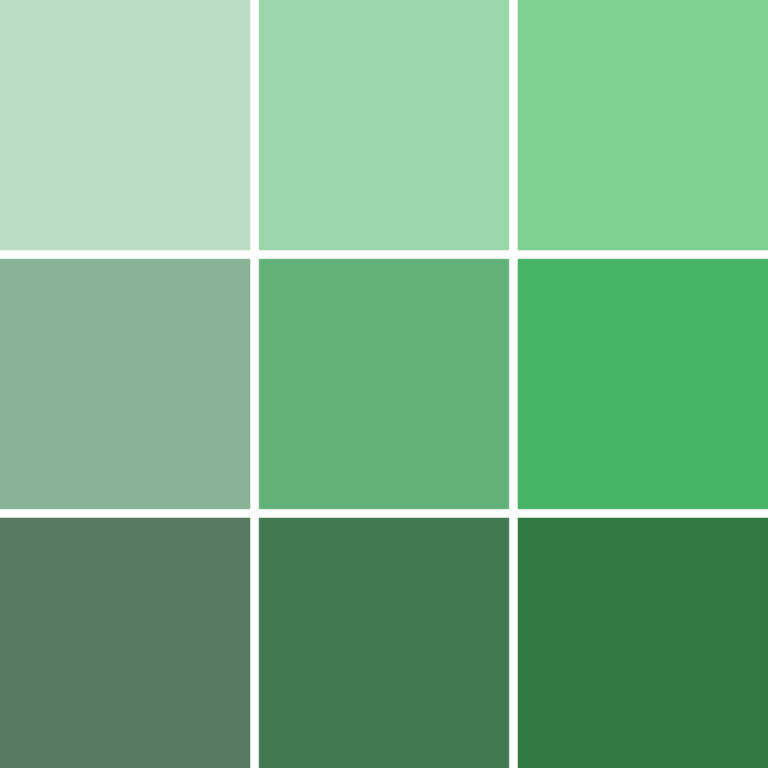
Green is the color of growing things. It’s balance, rest and renewal, the color your eyes evolved among and the one most of us relax into without thinking.
Green is one of the earthy warm colors, with warm neutrals, red, orange and yellow. Together they are the home colors of Springs and Autumns. See all ten on the color wheel in Color Families.
This post is part of my Color Library, where I go deep on one color at a time. For the big picture of every color family, start with The Color Spectrum.
Warm green vs. cool green
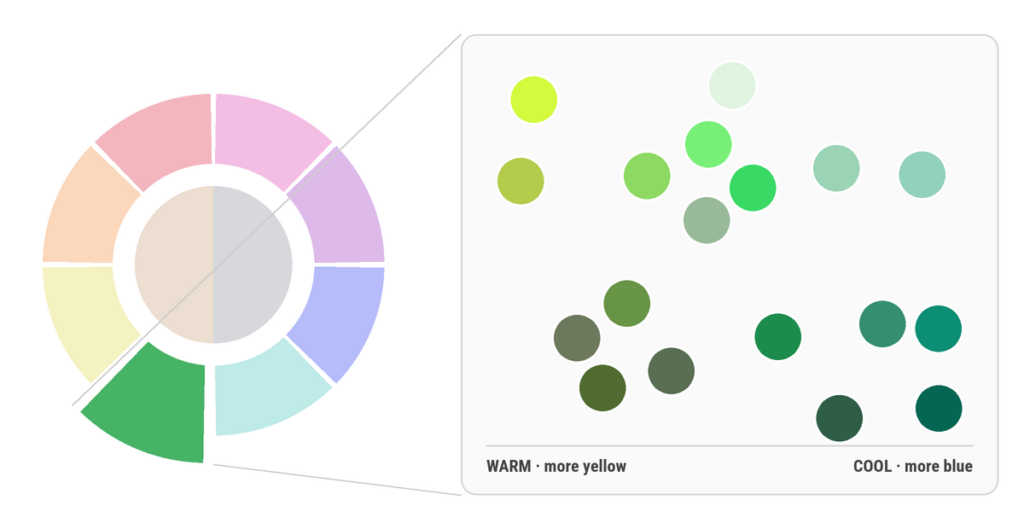
Every color family has a warm side and a cool side. Pull green out of the wheel and you can see it: the dots on the left have more yellow, the dots on the right have more blue. Higher dots are lighter, lower dots are deeper. (More in Undertone.)
Warm, more yellow. Warm greens lean yellow: lime, moss and olive.
Cool, more blue. Cool greens lean cyan: emerald, jade and pine.
Find your green by skin tone
Every color family has a version for every skin tone, and a depth that matches yours. Find your zone, then follow your skin’s depth across: lighter skin, lighter shade; deeper skin, deeper shade.
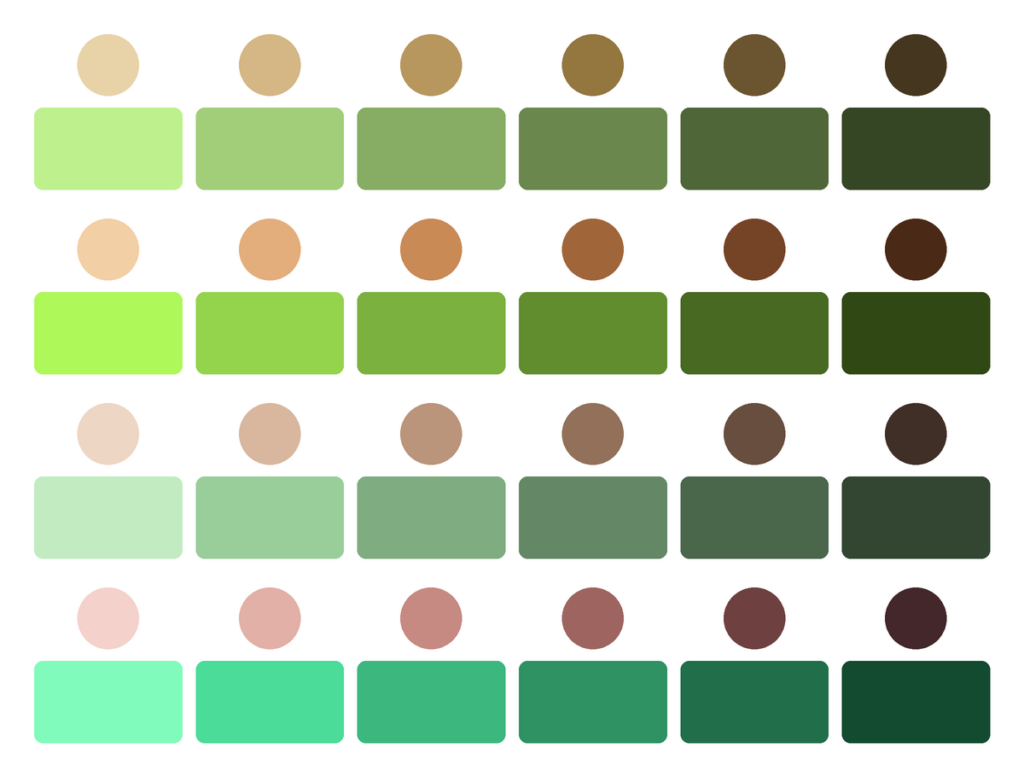
Top to bottom: olive, warm, soft neutral and cool skin. In each row, skin from light to deep sits above its best green. Find your row, then your depth.
Here are my dyes for each skin tone:
- Warm skin: 066 Lime Pop, 069 Electric Green, 068 Lime Squeeze, 061 Avocado, 062 Muir Green, 063 Moss Green, 067 Bright Green, 070 Kelly Green, 065 Sage Green, 071 New Emerald Green, 064 Olive Drab
- Cool skin: 075 Sea Glass, 077 Celadon, 074 Forest Green, 078 Mermaid’s Dream, 072 Better Blue Green, 073 Dark Green
- Olive skin: 061 Avocado, 062 Muir Green, 063 Moss Green, 065 Sage Green, 064 Olive Drab, 073 Dark Green
- Soft Neutral skin: 076 Seafoam, 065 Sage Green, 075 Sea Glass, 077 Celadon
Every green in my collection
Every one of my dyes in this color. Tap a shade to see its hex code, or add it to your cart.
Green by color genre
Every color can be light or deep, soft or clear. Here’s green in all nine color genres. Learn all nine in Color Genres.
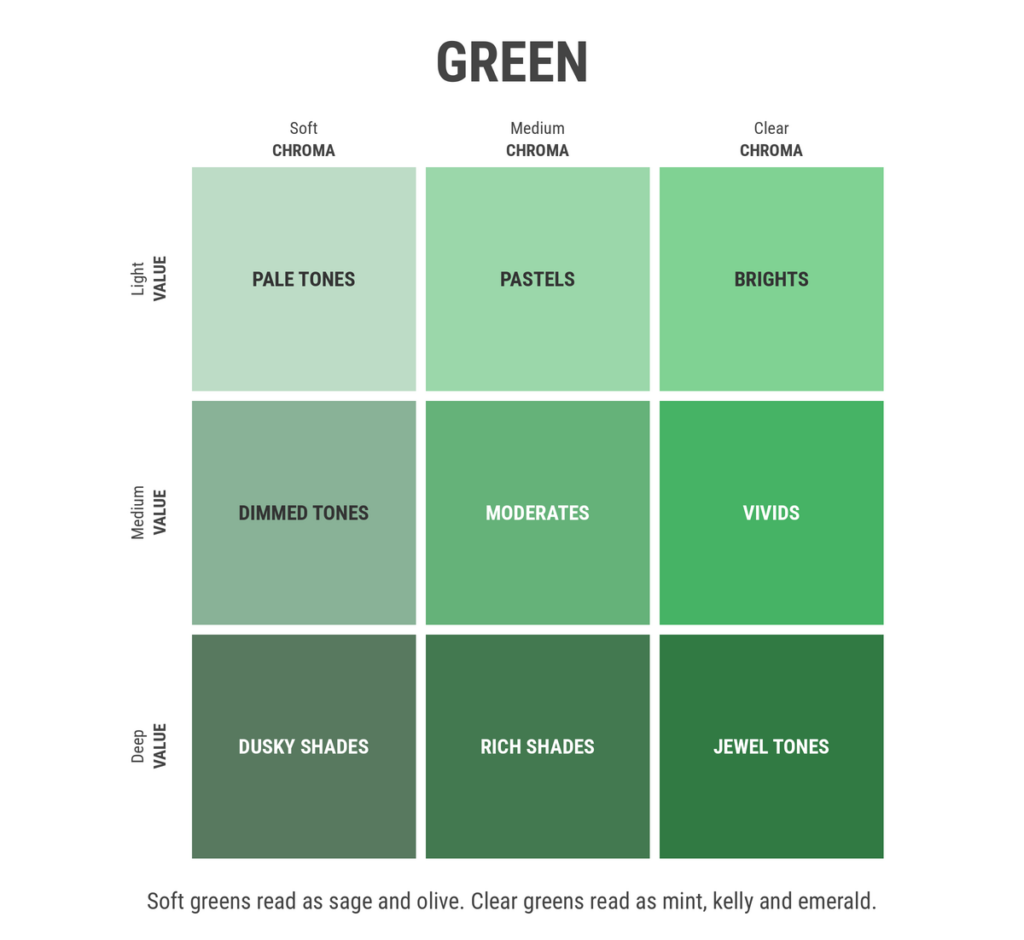
My best matches in each genre, top row to bottom:
- Pale Tones: 075 Sea Glass, 076 Seafoam, 077 Celadon
- Pastels: none of my green dyes yet. Closest: 067 Bright Green
- Brights: 066 Lime Pop, 067 Bright Green, 068 Lime Squeeze, 069 Electric Green
- Dimmed Tones: 065 Sage Green
- Moderates: 061 Avocado, 074 Forest Green
- Vivids: 070 Kelly Green
- Dusky Shades: 062 Muir Green, 064 Olive Drab
- Rich Shades: 063 Moss Green, 073 Dark Green
- Jewel Tones: 071 New Emerald Green, 072 Better Blue Green, 078 Mermaid’s Dream
What colors go with green?
Anyone can make a pretty palette. These are made from my dyes, so you can see how each pairing dash-dyes. Each harmony comes in a light set and a deep set of four. Tap a swatch for its hex code, or add it to your cart. The why behind each one is in Color Harmony.
Monochromatic
One color family in different values. The calmest way to wear a lot of green: same color, different depths.
Light
Deep
Analogous
Neighbors on the color wheel. They share a little of each other, so they blend into one mood.
Light
Deep
Complementary
Opposites on the color wheel make each other brighter. Let one lead and use the other as the accent.
Light
Deep
Split complementary
Green with the two colors beside its opposite: the energy of opposites with a softer landing.
Light
Deep
With neutrals
warm greens love cream and camel. Cool greens love gray, navy and black.
Build a palette around your green
Pick any of my green dyes, type a hex code or upload a photo. You’ll see palettes built around it, and the dyes from all 150 that match.
Palettes by ColorSpace. Open full screen ↗
Start with a color
Type a hex code, use the color picker, or upload a photo and tap the color you love.
What does green mean?
- Growth and renewal. Spring leaves, new shoots, fresh starts.
- Balance and rest. Green sits in the middle of the spectrum, neither warm nor cool at heart.
- Health and healing. Hospitals, pharmacies and “green” products borrow its calm.
- Go. Traffic lights and checkmarks use green for permission and safety.
The history of green
For most of history, a lasting green dye was surprisingly hard to make. Plant dyes gave greens that faded to yellow, so dyers often dyed cloth twice: first blue, with woad or indigo, then yellow, with a plant like weld. England’s famous “Lincoln green” was made this way.
In 1775, chemist Carl Wilhelm Scheele invented a brilliant green pigment that swept through wallpaper, paint and fashion. It contained arsenic, and in damp rooms it could make people sick. Today’s fiber-reactive greens are bright, lasting and safe.
How to wear green head to toe
- Pick a lane: olive, true green or blue-green.
- Mix values: Sage with Moss Green and Dark Green looks like a forest.
- Add texture: denim, knit and rayon in one family read as rich, not uniform.
- Add one point of contrast if you like: a rust scarf or a gold earring.
These portraits show green worn head to toe.
 Josh in Lime Squeeze
 Angel in Kelly Green
 Erin in Emerald Green
 Chance in Moss Green
 Nate in the Forest
 Amy in Sea Glass
From the runway
Solid color, head to toe, from my Autumn Rainbow and Vibrant Rainbow fashion shows. Tap a look to see the whole show.


Green, dash-dyed
Color tests from my studio: Wild Rags, Festival Scarves, Festival Sarongs and knits dash-dyed in green. Notice which ones your eye keeps returning to.


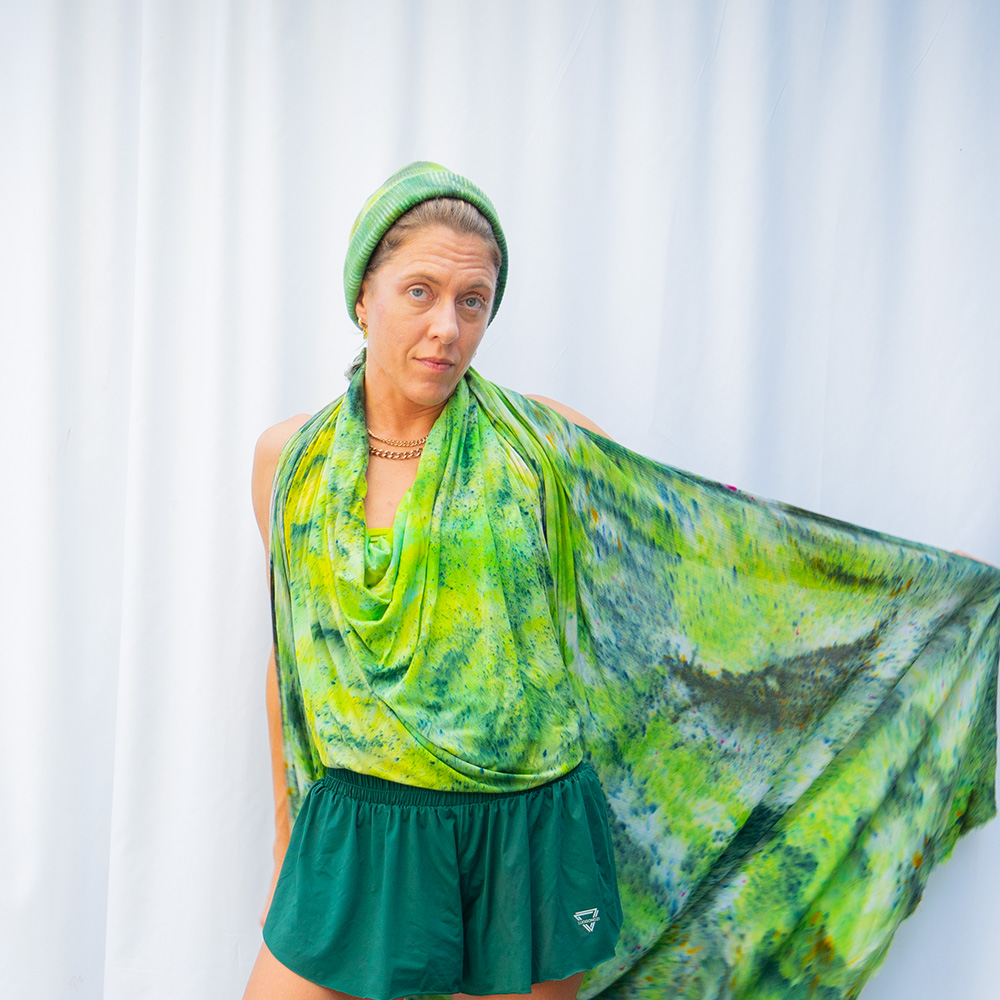


Want to wear these the way I do? Every tie is in Scarf Resources, with how to dye your own scarf.
Green in a dye session
Many greens are blends of blue and yellow molecules, so they can split beautifully on wet fabric. 075 Sea Glass opens into ocean gradients and 077 Celadon layers into soft pastels. Pair a splitting green with a steady one for movement and an anchor.
Your next step
Book A Color Revival
Three hours to revive your whole closet in the colors that are truly yours: an in-depth color analysis, a closet edit, six pieces dash-dyed as a capsule that mixes and matches, and ten styled photos of you in it.
Color genres come from Personal Color by Anuschka Rees.
More joy is possible.