Somewhere in your closet there is a piece you almost love. The shirt with the coffee stain. The dress that faded in the wash. The thrifted find in a color that was never quite yours. It fits, it’s comfortable and you never wear it.
That’s the perfect thing to dash-dye.
Upcycling is the heart of More Joy. Instead of buying something new, you give something you already own a second life, in the colors your body actually wants to wear. And when you do, you join one of the oldest traditions in human clothing.
A short history of upcycling clothes
For most of history, clothing was too valuable to throw away. Fabric took weeks to spin and weave by hand, so people mended, patched, re-dyed and remade what they had until it fell apart, and then they used the pieces for something else. “Upcycling” is a new word for a very old habit.
Japanese boro and sashiko
In rural Japan, families patched and re-patched indigo-dyed cotton for generations, layering scraps with simple running stitches called sashiko. The result, called boro (roughly, “rags”), was once a sign of poverty. Today boro textiles hang in museums, prized for the beauty of all that visible repair.
Re-dyeing to begin again
In many cultures, dyeing an old garment was how you gave it a new life or a new meaning. Clothes were over-dyed darker as they faded, and in some traditions, clothing was dyed black for mourning, then dyed again later as life moved on.
Feed-sack dresses
During the Great Depression in the United States, flour and feed companies noticed families were sewing clothes from their cotton sacks. So they began printing the sacks with florals and patterns. Millions of dresses, aprons and quilts were made from them.
“Make Do and Mend”
During World War II, with fabric rationed, the British government published a booklet called Make Do and Mend that taught people to darn socks, patch elbows and turn old coats into children’s clothes. Making something last became an act of care for your community.
Tie-dye and the 1960s
Tie-dye has roots in ancient resist-dyeing traditions like Japanese shibori and West African adire. In the 1960s it became a language of rebellion and belonging, and many people dyed thrifted and worn-out T-shirts into something joyful.
Visible mending and upcycling today
Today, with millions of tons of clothing thrown away each year, people are reclaiming those old skills. Visible mending, thrift flips and re-dyeing are ways of saying: this piece still has a story left in it.
How we upcycle at More Joy: dash-dyeing
At More Joy Studio, we’ve developed our own way of dyeing called dash-dyeing. It carries all of that history into now, with one big change: you’re in charge of the pattern while it’s happening.
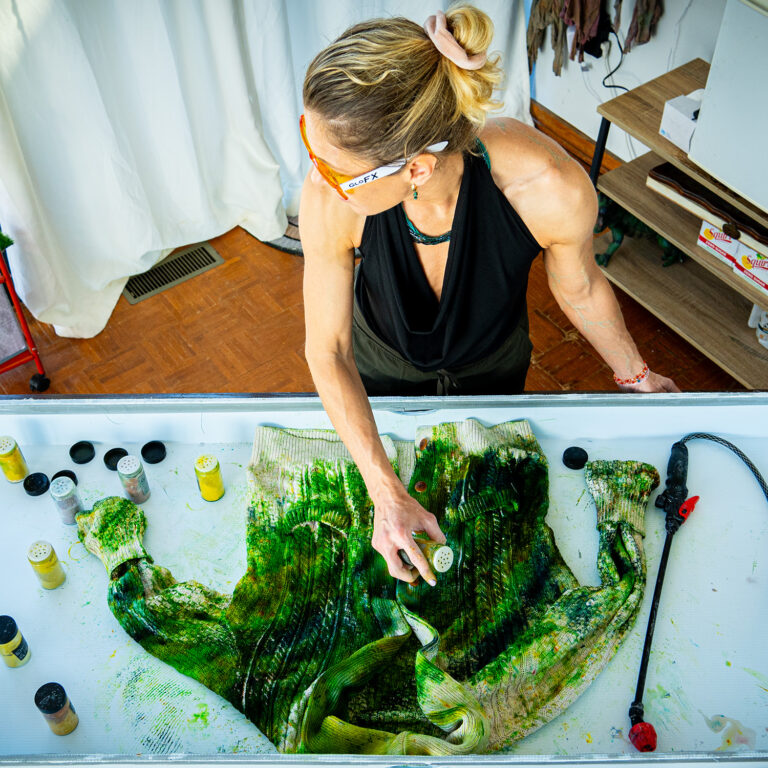
Most tie-dye asks you to soak your garment in soda ash, fold or scrunch it, bind it, squirt or ice it, then walk away for hours and let gravity decide. Dash-dyeing skips the soak and the binding:
- Wet the piece and lay it out flat, draped or loosely gathered. No tying, no rubber bands.
- Sprinkle activated dye. My dye powders are pre-mixed with the fixative, so the color is ready to bond the moment it lands.
- Mist with soda ash and water to move the pigment around and let each dye particle do its thing.
- Decide as you go. Need more red in that corner? More coral along the hem? Add it. Too much? Stop.
Because the pigment lands dry and then travels, blended dyes separate into their parts as they move. That’s how we get color splits you won’t find in ice dyeing or bottle dyeing. And because you can stack the powder, blow it or scatter it in a burst, the patterns start to look like things we see elsewhere: fireworks, spills, bird wings, lichen and storm clouds.
I believe that choosing those abstract patterns for yourself, one decision at a time, is a way of listening to what you’re craving. The color bonds permanently with natural fibers, so the second life of your piece is a long one.
Pick the right piece
Look for clothing that has a good shape and a problem you can solve with color:
- Stains and spots. Dash-dye patterns absorb them. A grease spot becomes part of the bloom.
- Fading or yellowing. Light, tired whites take color beautifully.
- The wrong color. A shade that washes you out can be pushed toward one that lights you up.
Then check the tag. Plant fibers like cotton, linen and rayon will take the dye. Polyester won’t. If you’re unsure, Choosing Fabrics to Dash Dye has the full list.
Dyeing over color
You aren’t always starting with white, and that’s fine. Dye is transparent, so whatever color is already in the fabric mixes with what you add. Think of it like layering watercolor.
- Light pieces (white, cream, pastels, pale gray) give you the most freedom. Almost any color will show.
- Medium pieces work best with colors deeper than the original. Yellow over light blue turns green. Red over yellow turns orange.
- Dark pieces (black, navy, deep brown) won’t show much new color. If you love the shape, a bleach treatment first can open them back up.
Colors next to the original on the color wheel blend smoothly. Opposites can turn muddy where they overlap. (More in Color Harmony.)
The magic of color splits
Some dyes aren’t one color. They’re blends of several dye molecules, and as the pigment travels across wet fabric, those molecules move at different speeds and separate. One dash becomes two colors, then three. It’s called a color split, and it’s where people fall in love.
- Colors that split bring movement: Grecian Sea breaks into greens and blues, Coral Pink into peach and blush, Watermelon into red and pink, and Dances With Raisins into plum, brown and red.
- Colors that stay true bring clarity: Lemon Yellow, Fuchsia Red and Turquoise.
A splitting color creates movement. A solid color creates an anchor. Put them together on an upcycled piece and you get something that feels alive, and something no one else will ever own.
How to dash-dye a piece from your closet
- Wash it first to remove fabric softener, sizing and everyday oils that can block dye.
- Leave it damp, not dripping.
- Decide what to keep. Some buttons, thread and trim may stay their original color. Polyester thread often does, and it can look intentional.
- Sprinkle your colors. Start light. You can always add more. Include at least one splitting color.
- Mist with soda ash water so the pigment moves and splits.
- Let it set somewhere warm for at least four hours, or overnight for the richest color.
- Rinse in cool water until it runs clear, then wash on its own the first time.
Every step, with photos, is on How to Dash Dye.
Bring it to a Dash & Bag Day
The easiest way to upcycle is to bring your pieces to me. At a Dash & Bag Day, you choose from all 150 of my colors, dash your piece with my guidance and take it home bagged to set and rinse.
- Bring your own pieces: $10 per item dashed.
- Need a blank? T-shirts are $10, bandanas are $5 and good-quality donated whites are $10, plus $10 per item dashed.
Follow along on Facebook and Instagram to hear about the next one, or book a session for your group.
Retired uniforms, too
Businesses have closets too. Through Workwear Revival, I bleach, dash-dye and return a crew’s worn-out uniforms in a palette we build together, so stains become pattern and good garments stay out of the landfill.
When you’re done, you won’t just have a new favorite. You’ll have proof that what wasn’t working only needed the right shade.
Make your own
Ready to dash?
Try it at home with activated dyes, or come dye with me in the studio. I bring the 150 colors and the guidance; you bring the pieces.
More joy is possible.