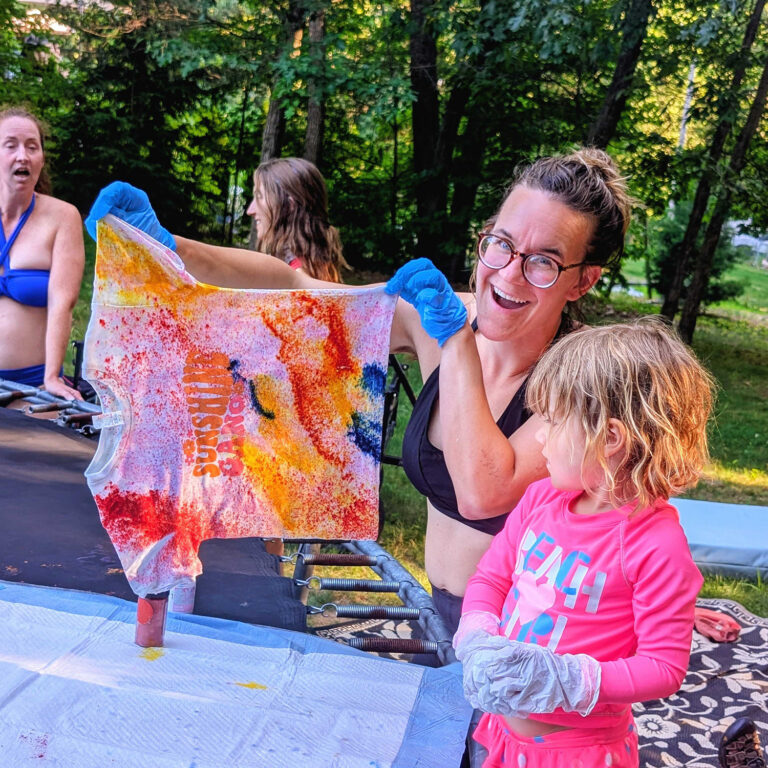
Because activated dye is a powder, it doesn’t need a dye bath. It can land on almost anything made from plants. That means a vintage outfit, a canvas tote, a pair of sneakers, a stack of napkins or even a plank of wood. If it’s made of natural fiber and it hasn’t been sealed, there’s a good chance it can wear color.
This post is the “what” to go with Choosing Fabrics to Dash Dye, which explains the “why.”
The one rule: it has to be made from plants
My dyes are fiber-reactive. They bond with cellulose, the structural fiber in plants, so the color becomes part of the material instead of sitting on top of it. Cotton, linen, hemp and rayon are all cellulose. So is raw wood. So is cotton canvas. That’s why one jar of powder can travel from a T-shirt to a table runner to a wooden sign.
What it won’t bond with is anything synthetic or sealed: polyester, acrylic, nylon, plastic, rubber, paint, varnish and stain guards. Those keep their color.
Things you can dash-dye
| What | Works best | Good to know |
|---|---|---|
| T-shirts, dresses, skirts and pants | Cotton, rayon, linen, modal | Rayon glows; cotton is softer and earthier |
| Vintage and thrifted clothing | Natural-fiber pieces with a good shape | Check the tag; older pieces are often all cotton or rayon |
| Denim jackets and jeans | Light or bleached denim | Dye shows best over pale washes |
| Scarves, bandanas and wraps | Rayon, cotton, linen | Small, quick and great first projects |
| Canvas totes, aprons and sneakers | Unprimed cotton canvas | Rubber soles and poly stitching stay as they are |
| Pillowcases, napkins, tea towels and curtains | Cotton and linen | Lovely gifts dyed in a set |
| Yarn, cord and rope | Cotton or hemp | Dye it before you knit, braid or macramé |
| Art canvas | Raw, unprimed cotton canvas | Gesso blocks dye, so skip pre-primed canvas |
| Wood | Raw, sanded, unfinished wood | Seal it afterward to protect the color |
Clothing: from your closet or the thrift store
Clothing is where most people start, and it’s still my favorite thing to dye. Look for:
- Pieces you almost love. Good fit, wrong color, a stain you can’t get out.
- Vintage finds. Older clothing is often all cotton, linen or rayon, which makes it ideal.
- Whites that have gone dingy. Light, tired fabric takes color beautifully.
- A full outfit. Dye a top, a scarf and a pair of pants together in one palette and they’ll match without being identical.
The full how-to for clothing lives in Upcycling Something From Your Closet.
Bleach and dye: recovering a piece you once loved
Some of the best pieces to dye are the ones that look finished: the black T-shirt that faded unevenly, the navy dress you stopped reaching for, the band shirt with a bleach spot. Dye is transparent, so it can’t make a dark piece lighter. Bleach can.
When you bleach a dark natural-fiber garment, you remove its color, and often reveal surprising tones underneath: black cotton can lift to rust, copper or pink. Then dash-dye goes on top, and the old piece becomes something new.
- Check the tag. Bleach and dye both need plant fibers: cotton, linen, hemp or rayon. Never bleach silk or wool.
- Bleach in a ventilated space, with gloves on, using a diluted bleach mix. Watch it closely and stop when you like the color.
- Stop the bleach. Rinse well, then neutralize with a bleach stop such as Anti-Chlor. Bleach left in the fabric weakens it and fights the dye.
- Wash, then dash. Prewash the piece, leave it damp and dye it like any other garment.
Recovery is a lifelong journey. I know that from my own life (I write about it in Recovery Through Practice), and I see it every time someone brings in a piece they had given up on. Recovering a piece of clothing you once loved can be life-giving. It’s a small, physical way of saying: this still has a story left in it, and so do I. That’s the heart of Embracing Stains as Places for Transformation.
Beyond clothing: canvas and home goods
Canvas is tightly woven cotton, so it takes dye well. The key word is unprimed: art canvas that’s been coated in gesso is sealed, and the dye will bead up. Raw canvas, canvas totes, aprons and canvas sneakers are all fair game. On sneakers, the rubber and most of the stitching stay white, which makes a crisp frame around the color.
Home textiles are wonderful to dye as sets. A stack of cotton napkins dashed in one palette, a linen table runner for a dinner party or pillowcases that match a quilt will all keep their color through years of washing.
Wood: yes, really
Raw wood is cellulose too, so activated dye bonds with it the same way it bonds with cotton. The grain soaks up color unevenly, and the result looks like stained glass or watercolor.
- Use raw, sanded, unfinished wood. Paint, varnish and pre-stained wood won’t take dye.
- Lighter woods show color best. Pine, basswood, birch and poplar are good places to start.
- Mist the wood first, sprinkle the dye, mist again, then cover it so it stays damp while the color sets.
- Seal it when it’s dry with a clear finish to protect the color.
Try a wooden sign, a cutting-board-sized plank for the wall, wood slices for ornaments, or picture frames.
What to skip
- Polyester, acrylic and nylon (they’ll stay their original color)
- Anything coated, sealed, painted or varnished
- Wool and silk with this method (they need a different kind of dye)
- Anything you’ll use for raw food prep, like cutting boards in daily use
Not sure? Test one small spot with a single color. It’ll tell you everything.
Bring it to a session
You’re welcome to bring your own pieces to the studio: clothing, scarves, totes, sneakers, napkins, small wood pieces or anything else natural you’d like to try. Come empty-handed and you can choose blanks here: T-shirts are $10, bandanas are $5 and good-quality donated whites are $10, plus $10 for each piece you dash.
Try this
Walk through your home and find three things made from plants that you’d never thought of dyeing: a canvas bag, a linen napkin, an unfinished wooden box. Pick the one that excites you most. That’s your next project.
Make your own
Ready to dash?
Try it at home with activated dyes, or come dye with me in the studio. I bring the 150 colors and the guidance; you bring the pieces.
More joy is possible.
Your next step
You can find a lot of this on your own
Find where your skin falls, save your palette card and dash a piece at home. When you want another set of eyes, I’m here.
- Explore for free: follow the guide, find your undertone and save your best shades.
- Personal Dye Session: one hour with me. We read your colors on your skin and dash three pieces together.
- A Color Revival: three hours to revive your whole closet. In-depth color analysis, a closet edit, six pieces dyed as a capsule, and ten styled photos of you in it.
Curious about the rest? Learn which fabrics take dye, how to tie a Wild Rag, or how neurodiversity shapes everything I make.
More joy is possible.